
In June 2024, Databricks agreed to acquire Tabular, a startup with roughly 40 employees, about $37 million raised, and, per Bloomberg’s later reporting, around $1 million in annual revenue. The price was never officially disclosed. CNBC reported over $1 billion on announcement day, the Wall Street Journal put it between $1 billion and $2 billion, and Bloomberg later settled on a figure close to $2 billion. Take the low end and Databricks still paid roughly a thousand times revenue for a company whose entire product surface was Apache Iceberg, an open specification anyone can download for free.
The timing said as much as the price. The deal was announced on June 4, day two of Snowflake’s own summit and one day after Snowflake unveiled Polaris, an open catalog for Iceberg built with AWS, Google, and Microsoft as launch partners. A week later, at its own summit, Databricks open-sourced Unity Catalog. Two vendors that had spent five years fighting over table formats spent seven days in June competing to look the most open.
A vendor does not pay ten figures for free software out of sentiment. The price makes sense once you trace what the table format war was for, why Iceberg ended it, and where the fight moved the day it ended.
Three companies built three formats, but one built for everyone
A table format is the metadata layer that turns a pile of files in object storage into something that behaves like a database table. It tracks which files belong to the table, what the schema is, and how both can change without corrupting anyone else’s reads. For a decade the default answer was Hive’s, which tracked tables as directories of files. We told the Netflix half of that story in Standing on the Shoulders of Open-Source Giants: queries spending more than nine minutes planning before reading a row, and concurrent writes that could silently return wrong numbers. Between 2016 and 2019, three companies replaced it, each for a different reason, and the reasons decided the war.
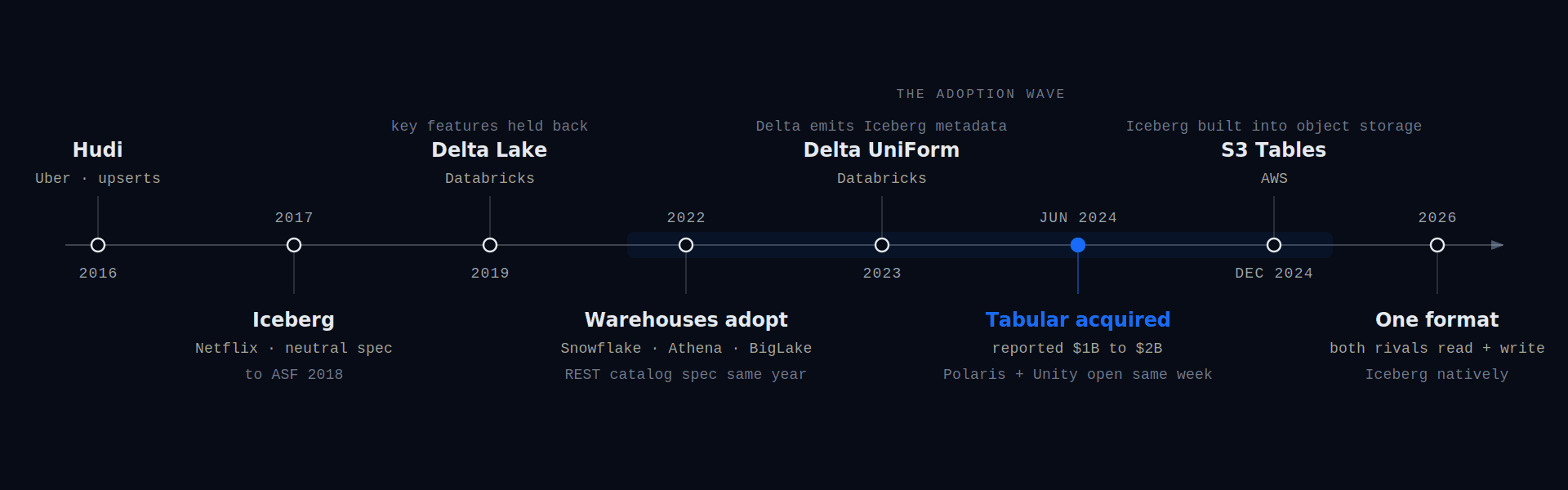
Uber built Hudi in 2016 because trip data changes constantly and Hadoop-era lakes had no efficient way to update a record in place. Hudi brought upserts and incremental processing to HDFS and cut Uber’s warehouse latency from hours to under 30 minutes. It was open-sourced in 2017 and became an Apache top-level project in June 2020. It is a serious piece of engineering, shaped end to end by one company’s streaming problem.
Databricks built Delta Lake to make the lakehouse viable on Databricks, and open-sourced it in April 2019 while holding the best parts back. OPTIMIZE, Z-order clustering, and multi-cluster writes stayed proprietary until Delta 2.0 in 2022. CEO Ali Ghodsi was candid about the model: “We found that we can move faster, build the proprietary version, and then open source it when it’s battle tested.” Delta was built to sell Databricks, which is a fine reason to build software and a hard place to grow a standard from.
Netflix built Iceberg as a specification first. Ryan Blue and Dan Weeks designed it around atomic commits and file-level tracking, donated it to the Apache Software Foundation in November 2018, and developed it in the open with engineers from Apple and Airbnb. Netflix sells subscriptions. It had no query engine to protect, no warehouse to feed, and nothing to gain from steering the spec anywhere except correctness. Line the three up by who needed what: Hudi needed Uber’s pipelines to work, Delta needed Databricks to win, and Iceberg needed nothing except adoption.
Then everyone adopted it, including the vendors with formats of their own
Snowflake moved first among the warehouses, previewing Iceberg support in January 2022, and its stated reasoning? They picked Iceberg because Iceberg was an open project “rather than merely open-source code.” The spec was governed by the ASF, so betting on it carried no counterparty. AWS shipped Iceberg-powered ACID transactions in Athena in April 2022, Google previewed BigLake support for Iceberg that October, Redshift followed in 2023, and Microsoft wired Iceberg into Fabric’s OneLake through a Snowflake partnership in May 2024. Confluent built Tableflow to materialize Kafka topics directly as Iceberg tables. Then in December 2024 AWS made the format a primitive of the storage layer itself: S3 Tables, which Amazon called the first cloud object store with built-in Apache Iceberg support.
The holdouts soon gave in. Delta UniForm, announced in 2023, taught Delta tables to generate Iceberg metadata so Iceberg readers could consume them, which is the kind of feature you ship when the other format’s readers are the ones that matter. In June 2025 Databricks announced full Iceberg support in Unity Catalog, readable and writable by outside engines, and took it GA in May 2026. By April 2026, Snowflake could write to Iceberg tables cataloged in Unity Catalog, each archrival operating natively inside the other’s territory through the same open interfaces. Snowflake CEO Sridhar Ramaswamy summed up the ending on an earnings call: “This is the end of the Betamax wars,” with everybody centering on the one format that had broad support.
Delta was arguably the better product, but it fell short
We have to give Delta its due. Delta was earlier to production hardening, had the deepest integration with Spark, the most widely deployed processing engine in the world, and by 2022 Databricks could claim more than 7,000 organizations running it on exabytes a day. If the war had been decided on integration depth or installed base, Delta had the stronger hand, and plenty of thoughtful engineers picked it on those grounds.
But the buyers who decided the war were choosing the format their data would live in for the next ten to twenty years, and with that mindset the evaluation flips from features to governance. A format controlled by one vendor carries a specific, unpriceable risk: every future improvement will be sequenced to benefit that vendor’s engine first, and the format will stay exactly as open as the vendor’s board finds convenient. Iceberg was the only format whose success required nothing from its creator. Netflix could lose interest tomorrow and the spec would keep evolving through the ASF’s public process, which is precisely what happened as Apple, AWS, Snowflake, and eventually Databricks staffed it. Iceberg PMC member Russell Spitzer put the buyer’s logic in one sentence: “If you bid on Iceberg, you aren’t going to get double-crossed sometime in the future.” Brian Olsen, then in the Trino community, called the ending in mid-2023 on the same grounds: what set Iceberg apart was an open, published specification rather than behavior defined by one implementation’s code.
Neutrality turned out to be the one feature a vendor cannot copy. Databricks could match any Iceberg capability, and over the years it matched most of them. It could not make Delta belong to no one.
What a billion dollars buys when the software is free
So if the format was already a commodity every engine could read, what did Databricks pay for? Two things, and neither is actual code.
The first is the people who steer the spec. Blue and Weeks did not stop shaping Iceberg when they sold; they now do it from inside Databricks, who get to put their stamp on the Iceberg v3 announcement. Approved in 2025, v3 added deletion vectors in the same binary format Delta uses, and the v4 proposals go further, with Delta 5.0 planned to adopt Iceberg v4’s metadata structure outright. The two formats are converging, and the engineers steering the convergence collect Databricks paychecks. That is not a criticism — the spec process stays public and community-governed. It is simply what standards influence costs when you cannot own the standard. One report, never confirmed by either company, had Snowflake bidding against Databricks for Tabular, which if true prices the same logic from the other side of the rivalry. Iceberg PMC member Russell Spitzer, watching from inside the community, gave the deal its driest read: “Spending that much money to contribute to Apache Iceberg is… well, it’s a decision.”
The second is position in the next control point. In 2022 the Iceberg project added a REST catalog specification, a standard HTTP interface to the catalog, the service every engine must ask which tables exist and whether it may touch them. That one spec broke the engine-to-catalog coupling that had kept metadata boring, and it explains the June 2024 week better than the acquisition does. Snowflake opened a catalog. Databricks opened a catalog. Both moved within seven days because once the format layer went neutral, the catalog became the last layer where a vendor can still sit between every engine and your data. Format neutrality without catalog and governance neutrality relocates the meter rather than removing it.
Standardizing on Iceberg only settles the storage
If your team is standardizing on Iceberg, you have made the right call. We made that case in April, and the months since have only strengthened it: your tables are now readable by every engine that matters, portable across clouds, and safe from any one vendor’s roadmap. The community’s health is easy to check in person: this year’s Iceberg Summit drew over 600 attendees across two days of sessions on the v4 spec, with Snowflake and Databricks engineers presenting side by side. What the format cannot settle is who governs access to those tables. Whether your estate is portable depends on who operates the catalog, whose identity model the policies are written in, and whether a rule defined for one engine follows the table when a different engine reads it. Those questions are exactly where the vendors who just lost the format war are now most active, and their catalogs are the new terrain.
This is one of the key reasons why we built NexusOne. Iceberg is the platform’s native table format: Trino, Spark, and Kyuubi read and write the same tables in place, on any S3-compatible object store, and one-click CDC mirroring moves changes from transaction systems into Iceberg without a Kafka pipeline in between. We patched Kyuubi so Spark and Trino resolve one catalog namespace, which lets a single Ranger policy govern a table no matter which engine touches it. And at the layer above the format we contribute to Apache Gravitino, an open federated catalog, work we described here, because the catalog question deserves the same neutrality the format question just settled.
The table format war ended the way standards wars usually end, with the neutral option winning and the losers writing very large checks for influence over what they could not own. The catalog war is just getting started, and it will decide more than the format war did. That story is next week’s piece. In the meantime, if you are settling your table format and want to see what the estate above it should look like, book an expert consultation at www.nx1.io/get-demo.